Table of Contents
Message from the President
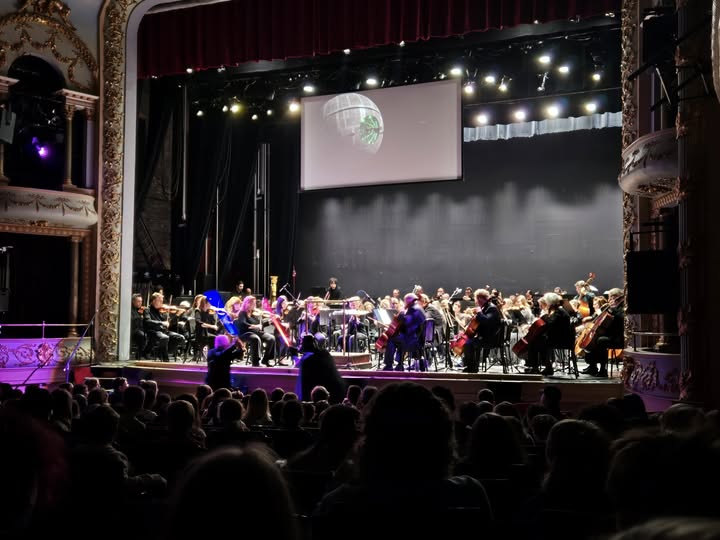
The Portsmouth Symphony Orchestra’s 28th season offers plenty to anticipate—including three Main Stage performances, two Holiday Family Pops! concerts, and the return of our Family Matinees chamber music series. We are especially thrilled to open the season on September 20 with Itzhak Perlman, celebrating the debut of our Guest Artist Series which is made possible by the Performing Guest Artist Fund, established in January 2025 through the generosity of Dr. Clinton Frederick Miller II and Laurel Miller.
This year also brings exciting growth. We are expanding our Main Stage series with a performance at York Community Auditorium and introducing a new chamber music series at Christ Church Episcopal in Exeter, NH—two important steps in bringing the PSO’s music to even more communities across the Seacoast.
Last season set a high-water mark for artistry, with ambitious and unforgettable performances under the baton of Music Director John Page. Beyond the stage, the generosity of our supporters enabled us to expand our educational programming—from small ensemble school visits to the return of our Explore + Learn concert at The Music Hall, part of its School Day Series.
Our smaller ensembles, including the Principal Winds and Portsmouth Brass Quintet, continue to play a vital role in this work. We were proud that the Principal Winds were recognized this June by the New Hampshire State Council on the Arts for their artistry and commitment to education.
Each season, the PSO relies on the collective support of our corporate sponsors, individual donors, foundations, community partners, and of course, you—our audience. Your commitment makes it possible for us to keep high-quality performances accessible across the Seacoast, even as costs rise.
Whether this is your first concert or you are a longtime subscriber, welcome. On behalf of everyone at the PSO, thank you for being part of our community and for helping us ensure that the music endures.
David Young
President of the Board of Directors
Message from the Music Director
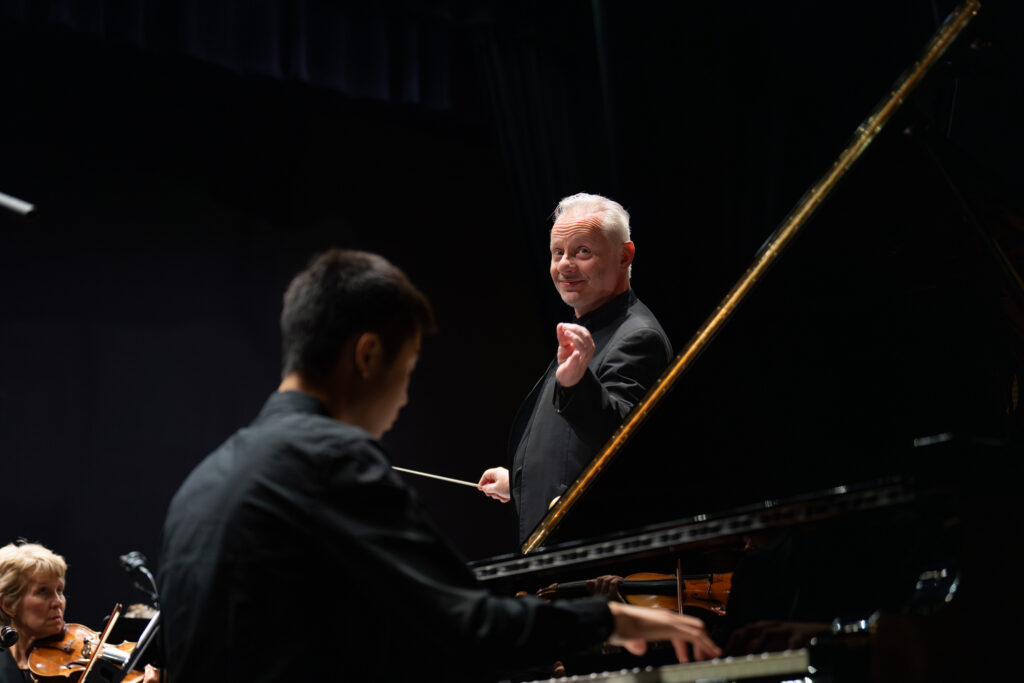
The 2025-2026 season promises to be one to remember, beginning in September with a special event with The Music Hall featuring legendary violinist Itzhak Perlman.
Our October Main Stage concert, featuring two Austrian composers who were both considered masters of harmony, will be performed for the first time in two locations—in Portsmouth, NH and in York, ME. We’ll return again to both these stages in December for two afternoon performances of our Family Holiday Pops! concerts.
In March, local pianist Mike Effenberger will be joining us for a performance of Gershwin’s “Rhapsody in Blue.” The program also features Florence Price’s Symphony No. 1 and Jessie Montgomery’s Starburst for String Orchestra. These historically marginalized composers bring long-overdue representation and cultural relevance to the classical concert stage, creating opportunities for audiences of all backgrounds to see themselves reflected in our programs.
And then finally, bringing the Main Stage season to a fittingly dramatic conclusion in June, are two works by Beethoven and Tchaikovsky that embrace the spectrum of human experience. This will also be our chance to celebrate the talented winner of the 2026 Young Artist competition.
As you plan your time with us this season, I encourage you to join me in The Music Hall for the Inside the Music pre-performance talks, which are meant to heighten the experience and make the musical program more accessible for both life-long and new classical music lovers.
Our work to entertain, educate, and encourage the musicians and audiences of today and tomorrow will continue next season through our small ensemble performances at local schools, and with our Explore + Learn concert that is part of The Music Hall’s School Day series.
In addition, you can find our chamber ensembles performing around the Seacoast and we will be partnering with the Portsmouth Public Library to host our Family Matinees series.
I look forward to making musical memories together,
John Page
Music Director
Program Listing
Symphony No. 35, K.385, D Major “Haffner”
| Wolfgang Amadeus Mozart | ||
—Intermission— | |||
Symphony No. 4 in Eb Major “Romantic”
| Anton Bruckner | ||
Musicians
Violin I
- Jeff Pearson
Concertmaster - Daniel Faris
Assoc. Concertmaster - Olga Kradenova
- Onur Dilisen
- Paul Pinard
- Samuel Lyons
- Sophia Bernitz
- Eya Setsu
- Jill Good
- Louise Kandle
- Rachel Swanson
- Lorna Ellis
Violin II
- Ashley Offret*
- Susan Streiff**
- Caroline Drozdiak
- Abigail Sykes
- Lauren Alter
- Susan Holcomb
- Ashley Freeman
- Diana Bourns
- Kristin Sullivan
- Jeffrey Sullivan
- Aspen Barker
- Jessie Helie
Viola
- Theresa Jaques*
- Karen McConomy**
- Ken Allen
- Jan Heirtzler
- Mary Gallant
- Wendy Keyes
- Maggie Chutter
- Thalia Dain
- Aleksandre Roderick-Lorenz
- Jonathan Byrne
Cello
- Gary Hodges*
- John Acosta**
- Zachary Larson
- Marshunda Smith
- Fay Rubin
- Lauren Wool
- Kari Jukka-Pekka Vainio
- Melissa Ambrose
- Molly Hutchinson
- Priscilla Chew
Double Bass
- Moisés Carrasco*
- Joe Annicchiarico
- Nate Therrien
- Joel Johnson
- Jason Noah Summerfield
Flute
- Aubrie Dionne*
- Erin Dubois
Oboe
- Sarah Krebs*
- Amanda Doiron
Clarinet
- John Ferraro*
- Santiago Baena Florez
- Katrina Veno
Bassoon
- Melissa Grady*
- Rick Shepard
Horn
- Orlando Pandolfi*
- Kathleen Keen
- Susan Williams
- Angela DiBartolomeo
- Nicholas Kneupper
Trumpet
- Adam Gallant*
- Mark Zielinski
- Chloe Francis
Trombone
- Brandon Newbould*
- Katie Schraeder
Bass Trombone
- Phil Hyman
Tuba
- Crystal Metric*
Timpani
- Steve Cirillo*
Perform with the PSO
The Portsmouth Symphony Orchestra seeks classical musicians in the community to audition for a place in the orchestra.
We invite all musicians, from professionals and educators to devoted amateurs and highly accomplished students, to audition for a place in the orchestra. We are actively seeking experienced string players.
Program Notes
Symphony No. 35, K. 385, D Major
Wolfgang Amadeus Mozart
In July of 1782, Leopold Mozart sent his son a letter asking him to write a new symphony for their friend Sigmund Haffner, a wealthy Salzburg merchant and burgomeister. Some years earlier, Wolfgang had composed his Haffner Serenade for the wedding of Sigmund’s daughter. Now Haffner’s son, also named Sigmund, was to receive a title of nobility, and a new symphony was to be played at the celebration.
In a famous letter, Mozart replied to his father’s request: “Well, I am up to my eyes in work, for by Sunday week I have to arrange my opera [The Abduction from the Seraglio] for wind instruments . . . And now you ask me to write a new symphony! How on earth can I do so? . . . Well, I must just spend the night over it, for that is the only way; and to you, dearest father, I sacrifice it. You may rely on having something from me by every post. I shall work as fast as possible and, as far as haste permits, I shall turn out good work.”
The symphony was completed and the last parts of it shipped off by early August, a time when Mozart was not only busy arranging his opera, but was also occupied with preparations for his own wedding on August 4. He did not see the score again, until his father returned it to him some months later, so that he could use it in one of his concerts in Vienna. “My new Haffner symphony has positively amazed me,” he wrote, “for I had forgotten every single note of it. It must surely produce a good effect.”
In its original form, the work resembled more a serenade than the typical four-movement symphony. In addition to the movements that we now have, it began with an introductory march (K. 385a) and had a second minuet and trio (now lost). Mozart deleted both these movements and added flutes and clarinets to the outer movements when he prepared the symphony for a public concert of his music. That concert took place in Vienna on March 23, 1783, and the program split the symphony, using it as a kind of “sandwich” to unify the concert. It began with the first three movements of the symphony, followed by a variety of works, including piano concertos and piano solos played by Mozart himself, as well as vocal works, and it ended with the finale of the symphony. Splitting the symphony in this way might well offend our modern sense about the integrity of a multi-movement work; we expect to hear a piece from beginning to end. But it was not uncommon for composers such as Mozart and Haydn to perform these operations on their own symphonies, using them as bookends to unify an entire program. Mozart’s program and his new symphony were a resounding success with the public, with critics, and with the emperor, who, contrary to his usual custom, stayed for the entire concert.
Program Notes by Martin Pearlman, Founding Music Director of Boston Baroque
Symphony No. 4 in Eb Major "Romantic"
Anton Bruckner
It’s common musicological coin to observe that there is little in the life and personality of Anton Bruckner that informs our understanding and appreciation of his music. While he composed a large body of significant sacred vocal music, it is his nine symphonies (the last not completed) that have established his importance as a major composer of the late nineteenth century. His is the story of a provincial man of extremely modest origins, of little early genius, and who endured decades of obscurity. And yet, despite inordinately long years of assiduous study and an innate obsequiousness, his patience gradually yielded widespread recognition of his talents and creations in early old age.
Even at the end of his active career, when he held a prestigious position teaching music theory at the Vienna Conservatory, he remained a curious rustic, simple in his eccentric ways, and naïve in the ways of the world. Many musical notables of his time could not restrain from ridiculing his peasant ways, his remarkable penchant for seeking hopeless relations with teenage girls, his bouts with obsessive counting of everything—including leaves on trees—and a bizarre fascination with the dead. That’s certainly burden enough on one’s chances of artistic success in the elegant, intellectual world of nineteenth-century Vienna, and yet Bruckner’s symphonies have come to assume an essential position in the development of that genre in late Romantic musical style. Though unique, they are nonetheless a link in the chain of evolution of the Austro-German symphonic tradition–from Beethoven and Schubert through to Gustav Mahler. While laboring in obscurity as a village schoolmaster, music teacher, and organist, his assiduous musical studies—right into his forties—gradually enabled him to develop a remarkable personal vision of symphonic form, texture, and psychological content.
His works are (in)famously long, repetitious, frequently really loud, often dense in texture, heavy with the brass, make frequent use of a rather rare rhythmic figure (more on this later), teeming with contrapuntal motifs, and often seem static in the absence of a sense of development and forward motion. But—these traits are not fatal, or even criticisms. They are an essential part of magnificent sound structures whose mystical, euphonious—and often recondite—nature unfolds at a leisurely pace, the musical logic of which often eludes one until the end.
He was a master of harmony and counterpoint, owing not only to his long years as a church organist and respected improviser on that instrument, but also to his detailed study of the subject, finally succeeding his famous teacher in Vienna at the Conservatory. His mastery of the richness of late-Romantic harmony often yields startling juxtapositions of chords and keys, unprepared dissonances, and advanced sonorities, but those are necessary elements of his pushing the musical boundaries of the time. He crafted new and involved systems of phrase structure and metrical analysis, and altered ways in which musical “landmarks” appear as his movements unfold. That’s a lot, no doubt, and accounts for much of the “Bruckner sound” for the listener.
Yet, notwithstanding all of these particular contributions to the development of the symphony, there is so much of the familiar in his approach. His works are in the conventional four movements, with variants of sonata form flanking the usual interior slow and scherzo/trio movements. The orchestral instruments are the usual for the time, except in the last three symphonies, which bring in Wagner tubas as reinforcement for the horn section. Unlike his successor and admirer, Gustav Mahler, he felt no existential need to incorporate the human voice, birdcalls, maudlin village bands, bundles of switches, mandolins, cowbells, and other novelties in the search for personal expression. In general, while much has been previously made of his admiration for Wagner and that musical style—it is generally clear to most, now, that his fundamental orientation is to the tradition of Mozart, Beethoven, and Schubert. He simply pushed the conventions of the symphony much further than did, say, Brahms. Given the constant revisions that he and his associates made to his symphonies, the many manuscript and printed versions, and even the two major collected scholarly editions of his oeuvre, there are multiple versions of all of them. His Fourth Symphony exists in at least three major versions. The “third” version from 1888—in yet a new edition, is based upon the latest scholarship. While the “second” version saw far more performances in the last halfcentury or so, the “third” is enjoying a renaissance.
The first movement begins with a typical Bruckner trait: a shimmering “halo” of strings from which mist the signature horn theme appears. The horn, of course, is the most “romantic” of instruments, and its choice here is not fortuitous—Bruckner’s adroit scoring imaginatively evokes the antique, and the instrument’s sound comes almost to dominate the whole work. As a conservative composer Bruckner did not plaster descriptive terms or programs to his works, but the Fourth Symphony is an exception, hence the moniker, “Romantic”-–in the sense of a medieval tale. He left behind several versions of the vague programmatic elements that underlay this work, and the idea of a brass instrument sounding the dawn from high in a tower is our inspiration here. At a leisurely pace the idea grows, replete with intimations of nature awakening and knights riding out on “proud steeds.” Finally, a huge orchestral swell leads from this tranquility to the advent of the heavy brass with the central theme of the movement, in his famous 2+3 rhythm. After an exploration of this stentorian idea, contrasting, lighter themes eventually arrive, redolent of graceful Austrian dances reminiscent of Schubert—replete, here, with the composer’s penchant for abrupt forays into distant keys. Soft, spooky, woodwind solos; quiet textures over rolling timpani; exuberant outbursts from the brass; and the opening horn motif are woven throughout the development, ending with a glorious brass chorale filling the hall. Bruckner is known for his innovations in musical architecture, and the recap is typical. It is not a literal recapitulation of the opening section, but takes its time to explore the material further, and not in a way that implies a looming close. Rather, his extensive coda ultimately gives the ear the harmonic signs that we have, at last, reached the denouement—signaled by dynamic unison horns proclaiming the opening motif. Like his idol, Wagner, Bruckner takes his time.
Bruckner’s slow movements are usually audience favorites, and this one is a particularly charming one, starting with a doleful tune over a “walking” bass. Later, a contrasting section offers a soft chorale. Moods and ideas alternate, including some cheerful moments, but Bruckner being Bruckner, this meditative interlude leads to an inevitable heroic triumph before the pensive end.
The scherzo and trio is the composer’s new one for the second version of the symphony from 1878. Deemed a “Jagd” (Hunting) scherzo by the composer, this movement also takes its programmatic inspiration from the Middle Ages. Unusually, the outer sections are not in the traditional three-beat meter, but in duple time, and are an absolute tour-de-force for virtuosic horn display—and all the brass, for that matter. Horses, dogs, deer—and horns–to the fore! The middle section is a gentle, Schubert-like Austrian Ländler, which Bruckner characterized as a mid-day repast for the hunters.
The finale, like the previous movement, is a significantly revised one. Opening with a long, throbbing pedal in the basses, tension builds as the horns and others intone a variant on a familiar motif that leads into a fortissimo imprecation from the brass of granite-like strength. Only Bruckner could have written and scored this, but it is certainly suggestive of the Wagner he adored—shades of Wotan’s Farewell. Soon the contrasting second group arrives, accompanied by the throbbing of the opening and we’re surrounded by a bucolic Austrian atmosphere. But, even in these salubrious tunes, listen for the inevitable interjection of the flatted scale step that has informed so much of this symphony—from beginning to end. It’s difficult to follow the ins and outs of Bruckner’s creative manipulations of sonata form, here, but the unity of the materials is palpable, nonetheless. Motifs, scale alterations, and the ubiquitous Bruckner 2+3 rhythm are all woven together as the finale unfolds at a leisurely pace, constantly shifting in moods. The long coda finally brings a sense of finality, in a buildup that is a sonic and psychological marvel. Probably far too much has been averred about the “influence” wrought by Wagner on his acolyte, Bruckner. But there can be no question but that while the former’s fingerprints are frequent in the latter’s work, Bruckner borrowed abstemiously and paid back with interest. He created his own, unique masterpieces, and this work is a noble and distinguished example.
–Wm. E. Runyan
© 2015 William E. Runyan
Keep the music playing!
When you support the Portsmouth Symphony Orchestra, you are helping musicians take the stage while also enriching the Seacoast’s cultural life, bringing high-quality, affordable classical music to your neighbors, and inspiring the next generation of music lovers—ensuring that the music endures.
Thank you for being part of the PSO community of supporters and for helping us to keep the music alive on the Seacoast!
As we launch our 28th season a generous donor has offered a $50,000 challenge match to help us raise $100,000 by the end of the day. If you have not already, we invite you to help us secure this match by making a donation today.
Up Next
Donorssince 2023
- Martha Fuller Clark
- Jameson & Priscilla French
- Clinton F. Miller, MD
- Donna Saunders & Michael Chubrich
- The Allayne & Douglas Wick Foundation
- Fay Rubin
- Jeffrey & Penelope Gilbert
- Jessica McKeon
- Jude Blake & Mike Bailey
- Lou & Kris Beaudette
- Bangor Savings Bank Foundation
- Barbara Sweet
- David & Sarah Young
- Katherine Wells Wheeler
- Karen Furtado & Mary Sargent
- Linda Connell
- Mike Schwartz & Sharyn Potter
- Mrs. Roger M. Doering
Albert Lantinen Barbara Henry & Nancy Winkley Barbara Sweet Craig & Shirley Peverly Diana Bourns Ellen G Saas Judith Blake Kate & David Murray
Karen McDonnell & Sam SmootLodowick Crofoot Lorraine T. Keazer Lucinda Spaney Margot Doering
M. Christine Dwyer
Michael Huxtable
Paul LanzoniQHT Inc. Robert & Cyndi Bear Steve Cirillo William Mathers William Quirk & Jean Berube
Anonymous A Caring Community
Anthony McManusBarbara & Robert Schultz Bruce Briggs & Katherine Kramer-Briggs
Mr. & Mrs. Bruce JohnsonCatherine Anderson Chuck and Demy Doleac Christopher & Stefanie Daly Edward & Janet Caylor Elizabeth Connell Nielsen Fred & Barbara Engelbach Jeanne & Derek Stern Kevin Bergesen & Laura Horton
Lawrence & Linda Ardito Lorraine Raleigh Mulhern & Scott, PLLC
Patrick Carey & Christopher Sturr
Priscilla BellairsSherrill Nixon Thomas Harford William Ceruzzi
Anonymous
Albert LantinenAndrea Sullivan
Anthony CoddingBrian Fitzgerald Bruce Valley Carol Seely Cynthia & Michael Harvell David & Marion Ellis
David Pope
Diane SchaeferElaine & Steven Molleur Elissa Margolin Elizabeth Gilbert Gary Hodges Jan & David Heirtzler John & Eimer Page John & Maureen Convery Joseph Stieglitz
Joyce & Donald MarchandJudith Howard & David Meikle Kathleen Tutone Kathy Rockwood Keith Lauder Leslie K Mast Lydia & Scott Meade Lynn DiElsi Michael & Glicka Kaplan
Michael Thiel
Orlando PandolfiThe New Hampshire Charitable Foundation’s Prince/Bergh Family Fund Rachel & Nate Swanson Richard Mechaber
Rick StantonRinda Madden Sally Crawford & Peter Wells
Sarah VealeStephen Chinosi Terrie Harman Wayne Shirley
Wendy Keyes
Adam & Mary Gallant
Alan H Bennett MD
Alan CalhounAlex Lanzoni Ann H Tarlton Anne Saer Anthony Codding Aubrie Dionne Bess4Sahara Black Birch Braden Ferrari
Brian GibbBridget Stearns Caroline & Nathanael Piper Carolyn Vinica Charles Bickford
Chris & Mimi BrettCliff Mommsen Cynthia Ryherd David A. Taylor Dianna Ferreira Don & Mary Jo Briselden Edwin Charle Elaine X Fuller Eric James Salas Erin Dubois Evelyn Laux Frances Ann Houlihan Frances Bechtold Frank Manter Fred Siegfried Gail Drobnyk Gary McGath Geraldine Gerbereux Glenda & Ed Fischer Helen Gettelman Helen Taft Ivor Freeman James Rosenfield Jane Page
John & Susan Herney
Judith ParksBilodeau Jo Ann B. Price Jo Ellen Thomas Joan Pratt
Joel E. JohnsonJohn & Susan Herney Joseph Kenick, Jr Judith N Moyer Kari Jukka-Pekka Vainio
Kathleen D RockwoodKathryn Ellis
Kathryn ThrallKeith Lauder
Kenneth FuldKristin Sullivan La Belle Chocolat
Larry Drake
Lauren JacobyLinda Cunningham Lindsey Humes Lynn & John Pincomb Mara Witzling & Peter Cass Maria & Richard Meyer
Marjorie Smith
Martha CaswellMartha E Stone Martha Thyng Marvin Fry
Marvin & Cynthia LeRoyMary Lou McElwain Matthew Dowd
Maureen NolanMelissa Ambrose Melissa Grady Michael & Glicka Kaplan Monte Bohanan Mr & Mrs Richard F Topping Mrs. Louise Hirshberg Nancy Zadravec Patricia Nicolino
Paul & Linda Hamlen
Paul Pelletier
Peggy Vagts & Mark MillerPeter Bowman
Philip DunphyPhilip R Hepburn OTTO Richard Meyer
Rick StantonRobert Westerberg Roy William Helsel
Russell GrazierSandra Quinlan
Seth A Hurd
Simon BasnerSusan Brett Susan Moniz Susanne Veal Suzanne Foley The McElroy Family Foundation Virginia MacDonald Anonymous Anonymous Anonymous
Anonymous
Board of Directors
- David Young, President
- Fay Rubin, Vice President
- James Mulhern, Treasurer
- Jan Heirtzler, Secretary
- Melissa Grady
- Paul Lanzoni
- Eric Salas
- Donna Saunders
- Rachel Swanson
Staff & Volunteers
- Erin Dubois, General Manager
- Aubrie Dionne, Director of Outreach
- Adam Gallant, Musician Coordinator
- Caroline Amport Piper, Director of Communications
- Jan Heirtzler, Librarian
- Graphic Details, Graphic Design
- Paul Lanzoni, Development Committee Chair
- Rachel Swanson, Marketing Committee Chair
- James Mulhern, Nomination and Governance Committee Chair
- Eric Salas, Orchestra Committee Chair