Message from the President
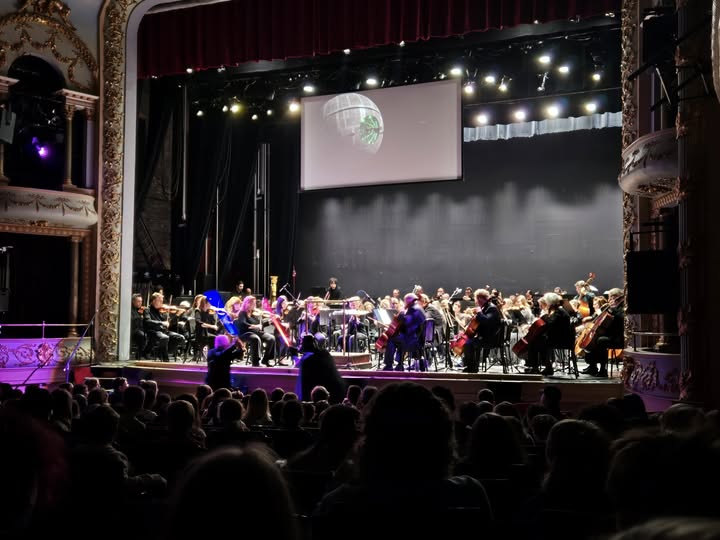
The Portsmouth Symphony Orchestra’s 28th season offers plenty to anticipate—including three Main Stage performances, two Holiday Family Pops! concerts, and the return of our Family Matinees chamber music series. We are especially thrilled to open the season on September 20 with Itzhak Perlman, celebrating the debut of our Guest Artist Series which is made possible by the Performing Guest Artist Fund, established in January 2025 through the generosity of Dr. Clinton Frederick Miller II and Laurel Miller.
This year also brings exciting growth. We are expanding our Main Stage series with a performance at York Community Auditorium and introducing a new chamber music series at Christ Church Episcopal in Exeter, NH—two important steps in bringing the PSO’s music to even more communities across the Seacoast.
Last season set a high-water mark for artistry, with ambitious and unforgettable performances under the baton of Music Director John Page. Beyond the stage, the generosity of our supporters enabled us to expand our educational programming—from small ensemble school visits to the return of our Explore + Learn concert at The Music Hall, part of its School Day Series.
Our smaller ensembles, including the Principal Winds and Portsmouth Brass Quintet, continue to play a vital role in this work. We were proud that the Principal Winds were recognized this June by the New Hampshire State Council on the Arts for their artistry and commitment to education.
Each season, the PSO relies on the collective support of our corporate sponsors, individual donors, foundations, community partners, and of course, you—our audience. Your commitment makes it possible for us to keep high-quality performances accessible across the Seacoast, even as costs rise.
Whether this is your first concert or you are a longtime subscriber, welcome. On behalf of everyone at the PSO, thank you for being part of our community and for helping us ensure that the music endures.
David Young
President of the Board of Directors
Message from the Music Director
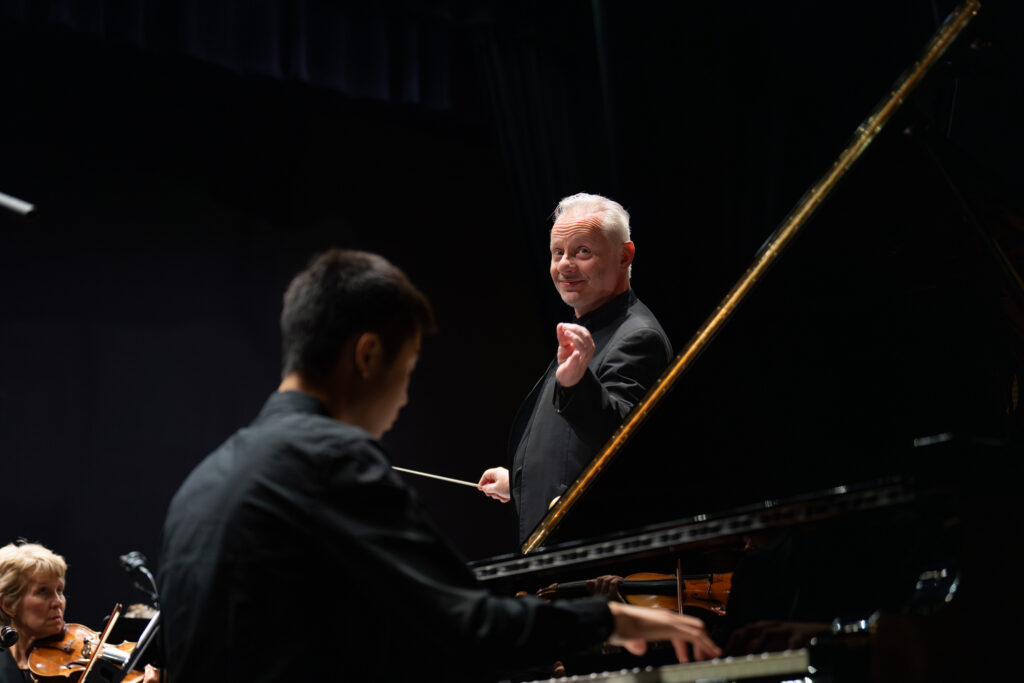
The 2025-2026 season promises to be one to remember, beginning in September with a special event with The Music Hall featuring legendary violinist Itzhak Perlman.
Our October Main Stage concert, featuring two Austrian composers who were both considered masters of harmony, will be performed for the first time in two locations—in Portsmouth, NH and in York, ME. We’ll return again to both these stages in December for two afternoon performances of our Family Holiday Pops! concerts.
In March, local pianist Mike Effenberger will be joining us for a performance of Gershwin’s “Rhapsody in Blue.” The program also features Florence Price’s Symphony No. 1 and Jessie Montgomery’s Starburst for String Orchestra. These historically marginalized composers bring long-overdue representation and cultural relevance to the classical concert stage, creating opportunities for audiences of all backgrounds to see themselves reflected in our programs.
And then finally, bringing the Main Stage season to a fittingly dramatic conclusion in June, are two works by Beethoven and Tchaikovsky that embrace the spectrum of human experience. This will also be our chance to celebrate the talented winner of the 2026 Young Artist competition.
As you plan your time with us this season, I encourage you to join me in The Music Hall for the Inside the Music pre-performance talks, which are meant to heighten the experience and make the musical program more accessible for both life-long and new classical music lovers.
Our work to entertain, educate, and encourage the musicians and audiences of today and tomorrow will continue next season through our small ensemble performances at local schools, and with our Explore + Learn concert that is part of The Music Hall’s School Day series.
In addition, you can find our chamber ensembles performing around the Seacoast and we will be partnering with the Portsmouth Public Library to host our Family Matinees series.
I look forward to making musical memories together,
John Page
Music Director
Program Listing
Coriolan Overture | Ludwig van Beethoven | ||
Cello Concerto No. 1 in Eb Major, Op. 107
with Ian Jang, cello | Dmitri Shostakovich | ||
—Intermission— | |||
Symphony No. 6 in B minor, Op. 74 “Pathetique”I. Adagio – Allegro non troppo | Pytor Ilyich Tchaikovsky | ||
Musicians
Violin I
- Zoia Bologovsky
Concertmaster - Nicole Wendl
Assoc. Concertmaster - Megan Fedor
- Sai-Ly Acosta
- Onur Dilisen
- Eya Setsu
- Louise Kandle
- Jill Good
- Jessica Helie
- Laura Sousa
- Rachel Swanson
- Lorna Ellis
Violin II
- Ashley Offret*
- Susan Streiff**
- Susan Holcomb
- Sam Lyons
- Todd Hamelin
- Abigail Sykes
- Lauren Alter
- Ashley Freeman
- Jeffrey Sullivan
- Elyana Schaer
- Kristin Sullivan
Viola
- Theresa Jaques*
- Karen McConomy**
- Mary Gallant
- Jan Heirtzler
- Wendy Keyes
- Ken Allen
- Caroline Drozdiak
- Carly Rockenhauser
- Maggie Chutter
- Thalia Dain
Cello
- John Acosta*
- Eli Kaynor**
- Zach Larson
- Molly Goldstein
- Fay Rubin
- Gianna Pompeo
- Chloe Jaarsma
- Melissa Ambrose
- Kari Jukka-Pekka Vainio
- Priscilla Chew
Double Bass
- Volker Nahrmann*
- Joe Annicchiarico
- Joel Johnson
- Nate Therrien
Flute
- Aubrie Dionne*
- Nicole Paquette
- Erin Dubois
Piccolo
- Erin Dubois
Oboe
- Sarah Krebs*
- Amanda Doiron
Clarinet
- John Ferraro*
- Santiago Baena Florez
Bassoon
- Melissa Grady*
- Rick Shepard
Contrabassoon
- Rick Shepard
Horn
- Orlando Pandolfi*
- Kathleen Keen
- Gray Ferris
- Angela DiBartolomeo
- Susan Williams
Trumpet
- Adam Gallant*
- Mark Zielinski
- David Shepherd
- Greg Bechtold
Trombone
- Brandon Newbould*
- Ben Sink
Bass Trombone
- Phil Hyman
Tuba
- Crystal Metric*
Timpani
- Steve Cirillo*
Percussion
- Timur Rubinshteyn*
- Alyssa Ostrowski
Perform with the PSO
The Portsmouth Symphony Orchestra seeks classical musicians in the community to audition for a place in the orchestra.
We invite all musicians, from professionals and educators to devoted amateurs and highly accomplished students, to audition for a place in the orchestra. We are actively seeking experienced string players.
Artist Biography
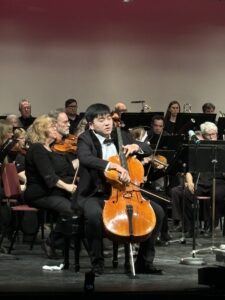
Ian Jang is a senior at St. Paul’s School and a young cellist currently studying in the New England Conservatory Pre-College program with Yeesun Kim.
Over the years, he has studied with distinguished teachers including François Abeille and Ophélie Gaillard. He has participated in masterclasses with renowned musicians such as Gary Hoffmann, Frans Helmerson, and Miguel Da Silva.
Ian has earned recognition through both solo and chamber music performances. His recent musical honors include winning the Lakes Region Symphony Orchestra Concerto Competition and the Richter Concerto Competition, as well as receiving the St. Paul’s Music Dickey Award, the school’s highest honor in music. He was also awarded support through the Zou Family Music Fund in recognition of his artistic promise and dedication. In addition, he has been accepted again to the Heifetz International Music Institute, one of the country’s most selective summer programs for young string players.
As a performer, Ian has appeared as a soloist and as a principal cellist in orchestral and chamber settings. He has served in ensembles such as the Singapore National Youth Orchestra and has taken on leadership roles in school and regional orchestras.
Ian is deeply committed to both performance and collaboration, and he is especially drawn to the expressive and communicative power of music. Whether performing as a soloist, playing chamber music, or leading within an orchestra, he values connection, sincerity, and thoughtful musicianship. These experiences continue to shape his artistic growth and have encouraged him to keep pursuing music at a high level.
A recipient of the Swiss Burkhalter Foundation Scholarship, Ian has been recognized for both his dedication and promise as a young musician. Through continued study and performance, he hopes to keep growing as an artist and to share meaningful musical experiences with others.
Program Notes
Coriolan Overture
Ludwig van Beethoven
Beethoven wrote a gaggle of overtures, some were admittedly weak (his heart really wasn’t into them, but his financial needs were), but most were what we expect of the man. Two of the four overtures associated with his opera, Fidelio, stand in the forefront of them, but the Coriolan Overture is a major work, as well. It was composed in 1807 as incidental music for a performance of the now obscure 1804 play by the same name by Heinrich Joseph von Collin—not for Shakespeare’s similarly titled work.
It’s a stormy composition, and perfect for a drama rife with tragedy and personal remorse. In short, Gaius Marcius Coriolan was a 5th century Roman general who had led successful campaigns against Rome’s enemies. Like so many foolish generals, he then developed political aspirations, but was unsuccessful, and was thrown out. In revenge he turned traitor and led an army of his former enemies to attack Rome. His mother entreated him to desist, but it was too late to turn back, and, in a fit of regret and shame, he committed suicide. Duty, Honor, Country, etc. Remember, 1804 was still the “classic” period in everything from literature, music, painting, and sculpture to furniture and Empire waistlines. So, themes of great Romans and their moral conflictions were all the rage, and still are universal.
The première was given in the home of Beethoven’s patron, Prince Lobkowitz, the year it was composed (that was usual in Vienna in those days, public concert halls were not.) Beethoven’s ambitions for music for drama are evident in the work, and for that matter, so is his natural talent for inherent musical drama. Commentators traditionally agonize over the natural awkwardness of forcing the linear nature of drama onto the “arch” form of sonata structure: drama moves on—sonata form returns to the beginning, etc. Well, Beethoven, like most opera overture composers, just worked around that dilemma. He doesn’t opt to “tell a story.” Rather he extracts the essence of the conflict. In Coriolan Beethoven sensibly constructs a work of just two musical ideas that respectively represent the central moral conflict of the drama: the turmoil of Coriolan’s desire for revenge, but with regret, versus his mother’s entreaties to desist in his terrible scheme.
Mozart’s most serioso key was G minor, and Beethoven’s was C minor. So, after several incisive lightening-strike chords, the pulsating, ominous theme of Coriolan in the latter key bolts off. When we reach the second theme, it’s a graceful thing of beauty, and, of course, it represents Coriolan’s mother pleading for him to desist from his certain tragic end. These are the simple conflicting elements from which Beethoven weaves his musical drama.
The sonata form is pellucidly clear, thus easy to follow. Remembering the time of composition—after Symphony No. 3 (“Eroica”) and before Symphony No. 5—the attentive listener will hear so much redolent of both symphonies. Thunderous off-beat accents, thorough development of melodic motifs, a repeated rhythmic figure that underpins the whole, and the conclusion of a movement that just quietly falls apart to dissolution—to just name a few. Beethoven opts to emphasize the lyric theme of the mother in the recapitulation, rather than the stormy Coriolan theme—saving it to the end for dramatic purpose. When it finally does appear, it is weak, fragmented, and certainly not bold. Coriolan’s quiet demise is clearly not heroic; rather, it evokes traditional definitions of classical tragedy.
–Wm. E. Runyan
© 2019 William E. Runyan
Cello Concerto No. 1
Dmitri Shostakovich
In his later years, the cellist, Mstislav Rostropovich, recalled a conversation that he had with Nina Vasilyevna, the wife of Dmitri Shostakovich. Rostropovich wondered what he could do to encourage Shostakovich to write a concerto for the cello. “Slava,” she answered, “if you want Dmitri Dmitriyevich to write something for you, the only recipe I can give you is this—never ask him or talk to him about it.”
Eventually, in July of 1959, Shostakovich did compose his First Cello Concerto, which he dedicated to Rostropovich. The famous cellist, who went on to give both the Russian and American premieres of the work, memorized the entire piece in four days. Rostropovich, a lifelong friend and chamber music partner of Shostakovich, had been one of the composer’s students at the Moscow Conservatory in 1943. Soon after, Shostakovich lost the teaching position amid an “anti-formalist” witch hunt by the Soviet cultural authorities. Partially inspired by Prokofiev’s Sinfonia Concertante, Shostakovich’s Cello Concerto No. 1 in E-flat Major, Op. 107 reflects, with sardonic defiance, a gloomy climate of terror and oppression that, only in the late 1950s, had begun to thaw.
In a preface to the score, Shostakovich wrote, “This four-movement concerto is divided into two large parts: the opening movement, and then three more movements played without pause. Together, they form an integral whole with unified themes and images.” The Concerto’s principal recurring theme is the four note motif which opens the first movement (Allegretto), where it is met with ghoulish woodwind retorts. The four notes are derived from the DSCH motif, a series of pitches which correspond to the composer’s initials using the German alphabet, and which return throughout his works. Here, as in Shostakovich’s turbulent Eighth String Quartet (1960), the motif repeats with obsessive persistence. It is a bold musical inscription which unrelentingly seems to assert the sanctity of the individual.
Shostakovich described this ferocious opening movement as a “jocular march.” Its ties to the composer’s score for the 1948 film, The Young Guard, which depicted Soviet soldiers being marched to their deaths by the Nazis, make the music seem all the more grotesque and sarcastic. Behind the terror lies the most ridiculous of military marches.
The First Cello Concerto is scored for a chamber orchestra. No brass instruments are used, apart from a single horn which becomes a predominant recurring voice. Raucously and almost mindlessly, it blasts out the principal motto. In the second movement (Moderato), the horn becomes a voice of distant lament. Here, the cello’s haunting melody rises over a gloomy ostinato. It grows into a passionate statement of anguish and despair which climaxes with a single timpani strike. In the final, chilling moments, the solo cello line dissolves into ghostly artificial harmonics and enters into a duet with the celesta.
Drifting into solitude, the third movement is a cadenza in which the solo cello reflects on the motifs of the previous movements. It is an intimate soliloquy which becomes increasingly agitated and leads directly into the final movement (Allegro con moto).
The Concerto concludes with a wild rondo, punctuated by shrieking woodwinds and timpani strikes. At moments, it takes the form of hideous circus music. Hidden within the music is a deformed version of Suliko, a Georgian folksong which was a favorite of Joseph Stalin. Shostakovich quoted the same song in his cantata, Rayok, a vicious satire of the Soviet system. In the final moments, the motif from the opening of the first movement returns and repeats, jeeringly. The final cadence arrives with timpani raps and the mocking blast of the horn.
Five Great Recordings
- Shostakovich: Cello Concerto No. 1 in E Flat Major, Op. 107, Mischa Maisky, Michael Tilson Thomas, London Symphony Orchestra Amazon
- Mstislav Rostropovich with Gennady Rozhdestvensky and the Leningrad Philharmonic Orchestra(live 1960 recording)
- Mstislav Rostropovich with Eugene Ormandy and the Philadelphia Orchestra
- Steven Isserlis with Avner Biron and the Israel Camerata Jerusalem
- Johannes Moser with Stanisław Skrowaczewski and the Frankfurt Radio Symphony Orchestra
Explore classical music with Timothy Judd at thelistenersclub.com
Symphony No. 6 "Pathetique"
Pyotr Ilyich Tchaikovsky
This symphony is Tchaikovsky’s last work—he died of cholera only nine days after its première—and it is universally hailed as one of his finest. It exhibits all of the characteristic passion and melodic beauty for which the composer justly is known, and is suffused with a dark and tragic essence. Tchaikovsky struggled all of his life with his identity, fears of social rejection, and frustrated relationships with others. By the end of his life these issues had surely come to a head, and the composer freely spoke with his brother of the reflection of his suffering in this final, gripping composition. There is even a current musicological fight over whether or not he poisoned himself to end his life (under threat of social disgrace), or deliberately drank the un-boiled glass of water during an epidemic. In any case, the circumstances of his life’s final struggles are manifest in this beautiful and tragic work. In the event, he had at first actually considered “Tragic” as a subtitle for the symphony, but his brother suggested the Russian for “pathos,” and the French equivalent, “pathétique,” is the evocative descriptor that we all know. But, be aware of inexact translations–there is nothing pathetic here.
The first movement is conventional in its form, but the mature composer exhibits a sense of tight construction, and weaves the movement with his characteristic contrast of exciting, dynamic motives and delicious lyrical melodies. The mood for the entire symphony is set at the very beginning by the brooding bassoon solo. The second movement is one of the most well known of his symphonic movements, cast as it is in five-four time, an absolutely innovative use of the metre in art music (is it not unknown in Russian folk music). The main theme and its manipulation is so smooth and adroit that it is altogether easy to forget the unusual time signature, and simply experience the music as being some kind of waltz with a “limp.” And remember, no one excelled Tchaikovsky in the waltz. The third movement is an exciting and optimistic march, but the heavy brass and snappy rhythms notwithstanding, it doesn’t seem a military march at all. Rather, it is a march from the world of the ballet—the Nutcracker and Sleeping Beauty come to my mind. No Shostokovitchian Russian soldiers are goose stepping here! The final movement in many respects is the characteristic movement of the symphony. It is most unusual in that it ends softly—very softly. No Romantic symphony had ever ended that way—they end loud and with a bang—right? And great applause! But in this case the agony and beauty of this reflection of the composer’s life and experience terminates in a final expiration that is remarkable for its challenging softness. “This is the way the world ends/Not with a bang but a whimper.”
–Wm. E. Runyan
© 2015 William E. Runyan
Keep the music playing!
When you support the Portsmouth Symphony Orchestra, you are helping musicians take the stage while also enriching the Seacoast’s cultural life, bringing high-quality, affordable classical music to your neighbors, and inspiring the next generation of music lovers—ensuring that the music endures.
Thank you for being part of the PSO community of supporters and for helping us to keep the music alive on the Seacoast!
Visit https://halcyonmusicfestival.org/ for more info.
Up Next
Donors
- Jude Blake
- Martha Fuller Clark
- Philip Dunphy
- Jameson & Priscilla French
- Clinton F. Miller, MD
- Donna Saunders & Michael Chubrich
- Jude Blake & Mike Bailey
- Lou & Kris Beaudette
- Margot Doering
- Stephen Gaykan
- David & Sarah Young
- Eric Macdonald
- Carolyn McConomy
- Barbara Henry & Nancy Winkley
- Bangor Savings Bank
- New Hampshire Charitable Foundation’s Christos Papoutsy Art Ventures Fund
- Springer’s Jewelers
- The Allayne & Douglas Wick Foundation
- Barbara Sweet
- CISCO
- Fay Rubin
- Jeffrey & Penelope Gilbert
- Jessica McKeon
- Katherine Wells Wheeler
- Karen Furtado & Mary Sargent
- Mike Schwartz & Sharyn Potter
- Paul and Janice Lanzoni
- Rosamond Thaxter Foundation
- CISCO
- Diana & Sam Bourns
- Ivor Freeman
- Karen McDonnell and Sam Smoot
- Lucinda Spaney
- The Medioli Family
- Mrs. Roger M. Doering
- Robert and Cyndi Bear
- Stuart Singer
- William Mathers
- William Quirk & Jean M. Berube
- A Fabulous Find
- Albert Lantinen
- Anonymous
- Beverly Reynolds Giblin
- Bruce Briggs & Katherine Kramer-Briggs
- Christopher Sturr & Patrick Carey
- Craig & Shirley Peverly
- Elizabeth Connell Nielsen & Devan Nielsen
- Jeanne & Derek Stern
- Joe Stieglitz
- Kevin Bergesen & Laura Horton
- Lorraine Raleigh
- M. Christine Dwyer & Michael Huxtable
- Michael & Glicka Kaplan
- Mr. & Mrs. Bruce Johnson
- Parma Recordings LLC
- Peg Reeves
- Priscilla Bellairs
- Sam’s Club Spark Good
- Steve Cirillo
- Thomas Harford
- Tim Hanson
- Tony McManus
- William Ceruzzi
- Andre Vanderzanden, MD
- Anonymous
- Anthony Codding
- Aubrie Dionne
- Barbara and Robert Schultz
- Brian Fitzgerald
- Bruce Valley
- Catherine Anderson
- Cynthia & Michael Harvell
- David & Marion Ellis
- David & Wendy Keyes
- David A. Pope Family
- Diane Schaefer
- Gail & Steven Lewis
- Jo Ann B Price
- Joann Rohde
- Joyce & Donald Marchand
- Kathleen Tutone
- Keith Lauder
- Lauren Jacoby
- Lawrence & Linda Ardito
- Lester Hochberg
- Lindsey Humes
- Louis F. Clarizio DDS
- Marty Thyng
- Michael Thiel
- Nancy Braese
- New Hampshire Charitable Foundation’s David and Kathleen Rushford Murray Charitable Fund
- Patricia Nicolino
- Richard & Anne Foley
- Rick Stanton
- Rinda Madden
- Sally Crawford & Peter Wells
- Sally & Alan Gayer
- Sarah Veale
- Sherrill Nixon
- Alan Calhoun
- Andrea Sullivan
- Andrew Jaffe
- Anna Boudreau
- Anna Howard
- Anonymous
- Anonymous
- Anonymous
- Anonymous
- Anonymous
- Averil Svahn
- Barry McArdle
- Becky Kates
- Bette Garrett
- Braden Ferrari
- Bridget Stearns
- Bronson de Stadler
- Bryan Buchanan
- Carol Cameron-Sears
- Caroline McElroy
- Caroline & Nate Piper
- Carolyn Vinica
- Cheri Bach
- Chris & Mimi Brett
- Chris Gantner
- Christina Strunk
- Chris Mommsen
- Cocheco Charitable Fund
- David A. Taylor
- David Lyon
- David Mahoney
- Deanna Armstrong
- Diane E Erwin
- Diane Robinson
- Dianna Ferreira
- Don & Mary Jo Briselden
- Edward & Angelynne Hinson
- Edward and Janet Caylor
- Edward Mehigen
- Edwin Charle
- Elisabeth Haynes
- Elizabeth Gale Lyon
- Elizabeth Gilbert
- Eric Francis
- Eric Salas
- Evelyn Laux
- Frances Ann Houlihan
- Frances Bechtold
- Francoise Elise
- Fred & Barbara Engelbach
- Gail Hill
- Georgia Flood
- Glenda and Ed Fischer
- James Scott
- James Shanley
- Jan & David Heirtzler
- Jane Bagnell
- Jeannette Webb
- Jennifer Searl Como
- Jo Ellen Thomas
- Joan Jacobs
- Joan Pratt
- Joan Widmer
- Joel E Johnson
- John & Susan Herney
- Judi Barba
- Justin Wright
- Kara Stuhr
- Kari Vainio
- Kathleen Rockwood
- Kathy and Dennis Donovan
- Kathryn Theall
- Kenneth Clark
- Kenneth Fuld
- Kristin Sullivan
- La Belle Chocolat
- Larry Drake and Joan Jacobs
- Lauren Wool and Jeff Bower
- Leslie K Mast
- Linda Anderson
- Linda R Cunningham
- Liz Mooney
- Mara Witzling & Peter Cass
- Marc Lessard
- Margaret Carol Dreyfus
- Martha Caswell
- Martha E Stone
- Marvin & Cynthia LeRoy
- Maureen Barbieri
- Maureen Nolan
- Michele Rhoten
- Michelle Flynn
- Monte Bohanan
- Mr. & Mrs. Richard F. Topping
- Nancy Gallant
- Nicholas & Lea Aeschliman
- Patricia Lundgren
- Patrick & Judy Parks
- Paul Pelletier
- Paula Rais
- Peggy Vagts & Mark Miller
- Peter Bowman
- Peter Grulke
- Phyllis Mackey
- RE Sandler
- Randall Mason
- Richard Bechtold
- Richard Meyer
- Robert Johnson
- Robert Westerberg
- Ronald & Lois Laurence
- Roy William Helsel
- Russell & Katie Grazier
- Sally Baybutt
- Sandra Quinlan
- Seth A Hurd
- Sharon Rice
- Simon Banser
- Steven Goddard
- Susan von Hemert
- Susanne Veal
- Suzanne Foley
- Tara Tracy
- The Red Door Pottery Studio
- Vic Lachance
- Vinny Barba
- Wayne Shirley
Board of Directors
- David Young, President
- Fay Rubin, Vice President
- James Mulhern, Treasurer
- Jan Heirtzler, Secretary
- Melissa Grady
- Paul Lanzoni
- Eric Salas
- Donna Saunders
- Rachel Swanson
- Susan Martore-Baker
Staff & Volunteers
- Erin Dubois, General Manager
- Aubrie Dionne, Director of Outreach
- Adam Gallant, Musician Coordinator
- Caroline Amport Piper, Director of Communications
- Jan Heirtzler, Librarian
- Graphic Details, Graphic Design
- Paul Lanzoni, Development Committee Chair
- Rachel Swanson, Marketing Committee Chair
- James Mulhern, Nomination and Governance Committee Chair
- Eric Salas, Orchestra Committee Chair