Message from the President and Music Director
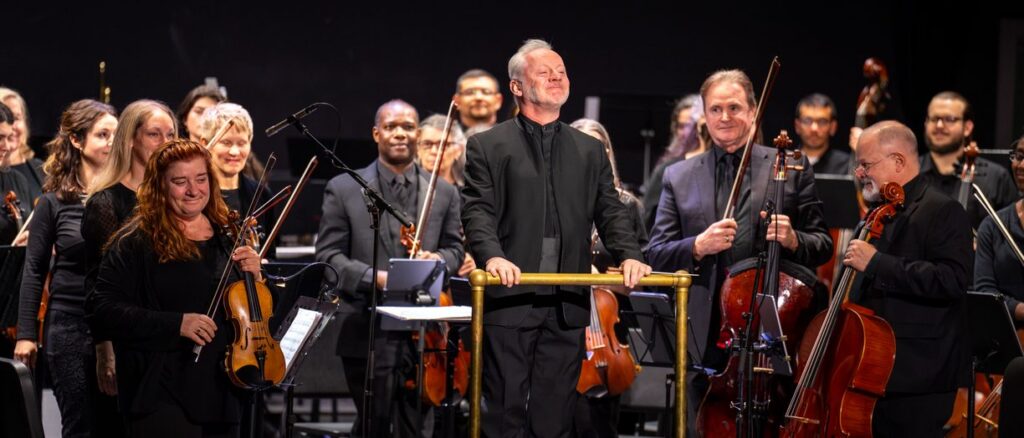
Strike Up the Band! is the Portsmouth Symphony Orchestra’s most important night of the year—our signature fundraiser and the moment that sets our entire season in motion. What happens in this room tonight is not just support for a single event, but the foundation that carries the PSO through the year ahead.
To our donors, thank you. Your presence here is what makes nights like this possible, and your generosity is what gives it meaning. This evening is a shared investment in the Orchestra’s future—one that ensures we can continue to perform, grow, and serve the Seacoast community with ambitious and accessible programming.
Because of your support tonight, the PSO is able to bring music to the stage all season long. That includes our Main Stage and Holiday Pops concerts, the continuation of the Family Matinees series, and performances reaching new communities throughout the Seacoast. It also makes possible our Guest Artist Series, which will welcome Joshua Bell in September, through the Performing Guest Artist Fund.
Just as importantly, Strike Up the Band! sustains the work that builds the Orchestra’s future: our education and outreach programs in schools, the Explore + Learn concerts at The Music Hall, and the Principal Winds and Portsmouth Brass Quintet as they bring music directly into classrooms and community spaces.
Everything begins with this night: where commitment becomes impact, where generosity becomes music, and where the season ahead is made possible.
Thank you for being here, and for making it all possible.
David Young
President of the Board of Directors
John Page
Music Director
Program Listing
Monte Bohanan, Master of Ceremonies | |||
Portsmouth Brass Quintet | |||
That’s a Plenty | Lew Pollack, arr. Steve Cooper | ||
The Entertainer | Scott Joplin, arr. Arthur Frackenpohl | ||
The Cascades | Scott Joplin, arr. Arthur Frackenpohl | ||
Selections from West Side StoryI Feel Pretty | Leonard Bernstein, arr. Jack Gale | ||
Portsmouth Symphony Orchestra | |||
Mississippi SuiteI. Father of Waters | Ferdé Grofe | ||
Symphony No. 1 in E minorIV. Juba | Florence Price | ||
—Intermission— | |||
Charleston | J.P. Johnson, arr. James Stephenson | ||
Rhapsody in Blue | George Gershwin | ||
Hoe Down from Rodeo | Aaron Copland | ||
Musicians
Violin I
- Zoia Bologovsky
Concertmaster - Megan Fedor
Assoc. Concertmaster - Eya Setsu
- Jackie Bensen
- Aspen Barker
- Jill Good
- Laura Sousa
- Elyana Schaer
- Rachel Swanson
- Diana Bourns
Violin II
- Ashley Offret*
- Susan Streiff**
- Travis Laughlin
- Todd Hamelin
- Skye Darling
- Abigail Sykes
- Lauren Alter
- Susan Holcomb
- Eden Harriman
- Kristin Sullivan
Viola
- Theresa Jaques*
- Caroline Drozdiak**
- Ken Allen
- Mary Gallant
- Wendy Keyes
- Eric Salas
- Thalia Dain
Cello
- Eli Kaynor*
- Marshunda Smith**
- Gianna Pompeo
- Molly Goldstein
- Fay Rubin
- Melissa Amrose
- Kari Jukka-Pekka Vainio
- Chloe Jaarsma
Double Bass
- Volker Nahrmann*
- Nate Therrien
- Joel Johnson
- Jason Noah Summerfield
Flute
- Aubrie Dionne*
- Kylie Elliott
Piccolo
- Erin Dubois
Oboe
- Sarah Krebs*
- Jill Hoffmann
English Horn
- Jill Hoffmann
Clarinet
- John Ferraro*
- Santiago Baena Florez
Bass Clarinet
- Katrina Veno
Bassoon
- Melissa Grady*
- Rick Shepard
Horn
- Orlando Pandolfi*+
- Angela DiBartolomeo
- Gray Ferris
- Susan Williams
Trumpet
- Adam Gallant*+
- Greg Bechtold+
- David Shepherd
Trombone
- Neal Melley*+
- Ben Sink
Bass Trombone
- Peter Freudenberger
Tuba
- Crystal Metric*
- Chris Quade+
Timpani
- Timur Rubinshteyn*
Percussion
- Alyssa Ostrowski*
- Michael Shun
Harp
- Sorana Scarlat
Celesta/Keyboard
- Jackson Carruthers
Perform with the PSO
The Portsmouth Symphony Orchestra seeks classical musicians in the community to audition for a place in the orchestra.
We invite all musicians, from professionals and educators to devoted amateurs and highly accomplished students, to audition for a place in the orchestra. We are actively seeking experienced string players.
Fluere Dance
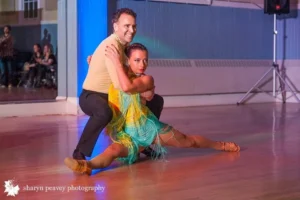 Fluere Dance is a Latin and Swing dance collective based in Portsmouth, NH. Fluere offers salsa, bachata, Brazilian samba, East coast and West coast wing, social dancing, and performance opportunities, creating an inclusive community where dancers can grow, connect, and share the joy of dance. Learn more at www.flueredance.com
Dancers: Nina and Morry El-Badry, Raechel and Ryan Lambert
Portsmouth Brass Quintet
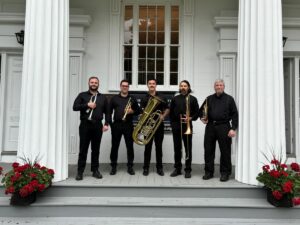 Though separated by nearly a century, the Portsmouth Brass Quintet carries forward the spirit of the 1920s dance hall band—a compact ensemble built for rhythm, character, and sheer musical drive. Founded in 2017 by principal trumpet Adam Gallant and drawn from the ranks of the Portsmouth Symphony Orchestra, the quintet delivers chamber music with flair, fire, and unmistakable personality, showcasing the full expressive power of brass in repertoire ranging from classical works to jazz, Broadway, and popular favorites.
While we know them from the concert stage, they also appear regularly in a very different setting—school programs, community celebrations, holiday events, and local gatherings across the region.
Program Notes
That's a Plenty
Lew Pollack
“That’s a Plenty” is a 1914 ragtime piano composition by Lew Pollack. Lyrics by Ray Gilbert were added decades later. Several popular vocal versions have been recorded, but it is more often performed as an instrumental.
The composition started as a rag but is nowadays played as a part of the Dixieland jazz repertoire. The song has been recorded by numerous artists and is considered a jazz standard. The first recording was on July 7, 1914, by Prince’s Band (Columbia A-5582),[3] and the New Orleans Rhythm Kings recorded their rendition in 1923.[4] In 1946 it was recorded by the jazz accordionist John Serry Sr. and guitarist Tony Mottola as members of the Biviano Accordion & Rhythm Sextette for Sonora records.[5] The comedian Jackie Gleason used it in his television shows in the 1950s and 1960s.[1]
Among the hundreds of later recordings of this standard, the following are particularly notable. Freddy Martin and His Orchestra recorded a version in 1950. Sheet music for this version featuring Freddy Martin on the cover has the lyrics printed inside. It was recorded by Albert Nicholas (clarinet), with the Big Chief Jazz Band, in Oslo on August 29, 1955, and released on a 78-rpm record (Philips P 53038).
Bing Crosby and Connee Boswell recorded a vocal version in September 1952 for use in Crosby’s radio show broadcast on November 27, 1952. Decca Records mastered this for commercial release on November 17, 1952.[6]
The Pollack and Gilbert song is not to be confused with a 1909 song of the same name by Henry Creamer and Bert Williams.
The Entertainer
Scott Joplin
Few pieces capture the spirit of turn-of-the-century America as vividly as Scott Joplin’s The Entertainer. Composed in 1902, the work is one of the most celebrated examples of ragtime, a distinctly American musical style characterized by lively syncopated rhythms and infectious melodies. Often called the “King of Ragtime,” Joplin helped elevate the genre from popular entertainment to an art form, composing works of remarkable craftsmanship and enduring appeal.
Although The Entertainer enjoyed popularity during Joplin’s lifetime, it experienced an extraordinary revival in the 1970s when it was featured in the Academy Award-winning film The Sting. The renewed interest introduced Joplin’s music to a new generation and helped cement the piece as one of the most recognizable melodies in American music.
In this arrangement, Joplin’s playful syncopations and jaunty tunes take on a bright, spirited character. The combination of trumpets, horn, trombone, and tuba highlights both the wit and elegance of the music, bringing the energy of a ragtime piano classic to life in a colorful new way. Perfectly suited to tonight’s Roaring Twenties-inspired celebration, The Entertainer remains as charming and entertaining today as it was more than a century ago.
Ain't Misbehavin'
Fats Waller
In 1929, the sounds of jazz were transforming American music, and Ain’t Misbehavin’ quickly became one of the era’s defining hits. Written by the legendary pianist and composer Fats Waller with lyricists Andy Razaf and Harry Brooks, the song debuted in the Broadway revue Hot Chocolates and soon found its way into dance halls, nightclubs, and radio broadcasts across the country.
The song’s playful lyrics express steadfast devotion in the midst of the excitement and temptation of city life. Paired with Waller’s effortlessly memorable melody, the result is a work that is both sophisticated and approachable—a hallmark of the jazz standards that emerged during the Harlem Renaissance. Waller himself was one of the most influential musicians of his generation, celebrated not only for his compositions but also for his charismatic performances and mastery of the stride piano style.
Over the years, Ain’t Misbehavin’ has become a cornerstone of the American Songbook, recorded by artists ranging from Louis Armstrong and Ella Fitzgerald to countless jazz musicians who continue to make the tune their own. Its combination of charm, humor, and rhythmic vitality has ensured its lasting popularity for nearly a century.
This brass quintet arrangement brings a fresh dimension to the familiar classic, allowing the ensemble’s rich sonorities and playful interplay to capture the song’s unmistakable swing and enduring appeal.
Selections from West Side Story
Leonard Bernstein
West Side Story is a tour de force of American music; its popularity is evergreen. Arguably Bernstein’s greatest work, it has taken its place as a masterpiece, not only in the context of Broadway musicals, but also as an icon in the larger musical life of the nation. But, its genesis was not spontaneous. The composer drew upon his successful experience in writing for the stage, as well as his deep engagement with the inspiring nature of New York City—a feeling for the place that only a native could have. While he astonished all with his amazing talents in almost every musical endeavor—he shirked at nothing—it is in musical theatre that he seemed naturally to flourish. He simply understood the genre and its demands.
He had plunged in early, writing for student productions at Harvard, and working with a cabaret group (that included Judy Holiday) while at student at the Curtis Institute. At the age of twenty-six his ballet Fancy Free was first performed at the Metropolitan Opera and On the Town opened on Broadway. Wonderful Town, Peter Pan, Facsimile, Candide, and, of course, West Side Story, followed in succession. Later works, like his still-controversial multimedia theatre piece, Mass (1971), and the unsuccessful musical, 1600 Pennsylvania Avenue, some critics point to as evidence of a weakening sense of his audience and times. But his masterpiece is clearly West Side Story, and has stood the test of time as a document of the Big Apple in the fifties.
It’s a masterful blend of pop sociology, bebop and Latin jazz, and a fantastic integration of dance. Bernstein had “big” ears for the jazz idiom—and came up with a score that rather better makes the case for “symphonic jazz” than did ever Gershwin or Copland. He simply had an innate feel for dance and for jazz rhythms and harmonies to which few “legit” composers could ever aspire. The “Symphonic Dances” were gleaned from the score of the musical in 1960 by Sid Ramin and Irwin Kostal, who had collaborated on the orchestration of the original show, working from Bernstein’s piano sketches. They were masters at their craft, and the score of the whole musical reflects it. In the suite one will hear the soaring “Somewhere,” a mambo and a cha-cha, the ultra cool “Cool,” and the gripping “Rumble” music, as this synopsis of a time-shifted Romeo and Juliet reaches its inexorable tragic conclusion.
–Wm. E. Runyan
© 2026 William E. Runyan
Mississippi Suite
Ferde Grofé
Composed in 1926, Mississippi Suite was Ferde Grofé’s first major concert work and remains one of the earliest examples of a distinctly American symphonic tone poem. Long before his celebrated Grand Canyon Suite, Grofé turned his attention to the Mississippi River, creating a musical journey that captures both the physical landscape and the cultural life that grew along its banks.
The four-movement work follows the river southward, from the pastoral calm of Father of Waters to the lively energy of Huckleberry Finn, the grandeur of Old Creole Days, and the exuberance of Mardi Gras. Along the way, Grofé weaves together original themes, folk-inspired melodies, and references to American musical traditions, painting vivid scenes of riverboats, small towns, and the diverse communities that shaped life along the Mississippi.
Grofé’s background as an arranger for Paul Whiteman’s orchestra—most famously orchestrating George Gershwin’s Rhapsody in Blue—gave him an extraordinary command of orchestral color. In Mississippi Suite, he uses the orchestra almost like a storyteller, employing rich textures and imaginative instrumental effects to evoke the sights and sounds of the river. The result is music that feels cinematic decades before the advent of film scores that would later define the American sound.
Premiered by Paul Whiteman and His Orchestra in 1926, Mississippi Suite was an immediate success and helped establish Grofé as one of the leading composers of American program music. Nearly a century later, its combination of sweeping melodies, colorful orchestration, and unmistakably American character continues to make it one of Grofé’s most enduring works.
Juba from Symphony No. 1 in E minor
Florence Price
By Rae Linda Brown
Written for the concert Common Ground performed on April 15, 1994 at Avery Fisher Hall at Lincoln Center.
In 1935 the African-American writer and composer Shirley Graham could boast of the accomplishments of America’s first African-American symphonists: William Grant Still, Florence B. Price and William Dawson. “Spirituals to Symphonies in less than fifty years! How could they even attempt it?” she asked in an article in which she recounts the development of African-American art music from the triumphs of the Fisk Jubilee Singers and their concert spiritual arrangements in 1871 to the critical acclaim of Dawson’s Negro Folk Symphony, premiered by the Philadelphia Symphony under Leopold Stokowski in 1934. William Grant Still’sAfro-American Symphony was premiered by the Rochester Philharmonic in 1931 and Florence Price’s Symphony in E minor was premiered by the Chicago Symphony in 1933.
What was the impetus behind the creation of the first symphonies by African-American composers? The spiritual inspiration came from the music of Samuel Coleridge-Taylor, an Anglo-African composer and concert violinist who visited this country three times between 1904 and 1910 and who had won fame as a conductor and composer in England. Keenly interested in African-American folk music, Coleridge-Taylor wrote several compositions based loosely or directly on this source material including the well-known Twenty-Four Negro Melodies, Transcribed for the Piano (1905) and Symphonic Variations on an African Air (1906, based on the spiritual “I’m troubled in mind”).
A more subtle but equally profound influence on African-American composers came from the “American” works of the Bohemian composer Antonin Dvorák who came to this country in 1892 to teach composition and to head the National Conservatory of Music in New York. During his three-year tenure here, the composer publicly advocated the use of African-American and Native-American folk music in composition to create a national American style. Dvorák heard African-American spirituals sung to him by his student Harry T. Burleigh, who would become one of America’s most celebrated baritone soloists and composers. Dvorák ’s “American” works–the String Quartet, op. 96 and Quintet, Op. 97 and particularly the Symphony No. 9 From the New World, premiered by the New York Philharmonic in Carnegie Hall on December 15, 1893 –provided inspiration for a generation of American composers.
Thus, two internationally respected composers (and not coincidentally, both European) validated, for both black and white American composers, the beauty of African-American folk music and led the way for its use in instrumental forms.
Nationalism was the backdrop from which African-American composers in the 1920s and early 1930s adapted old artistic forms into self-consciously racial idioms. The affirmation of the values of the black cultural heritage had a decisive impact on Still, Price, and Dawson, who had as their primary goal the incorporation of Negro folk idioms, that is, spirituals, blues, and characteristic dance music in symphonic forms. In the orchestral music of these composers, the African-American nationalist elements are integral to the style. The deceptively simple musical structure of their orchestral music is inherently bound to the folk tradition in which they are rooted.
Florence Beatrice Smith Price was born in Little Rock, Arkansas on April 9,1887. After receiving her early music training from her mother, she attended the New England Conservatory of Music, graduating in 1906 after three years of study, with a Soloist’s diploma in organ and a Teacher’s diploma in piano. There she studied composition with Wallace Goodrich and Frederick Converse and she studied privately with the eminent composer George W. Chadwick, the Director of the Conservatory.
After completing her degree, Price returned south to teach music at the Cotton Plant-Arkadelphia Academy in Cotton Plant, Arkansas (1906); Shorter College in North Little Rock, Arkansas (1907-1910); and Clark University in Atlanta (1910-1912). In 1927, now married and with two children, Florence Price and her family moved to Chicago to escape the racial tension in the south which, by the late 1920s, had become intolerable. Here Price established herself as a concert pianist, organist, teacher and composer.
Price’s Symphony in E minor was written in 1931. In a letter to a friend she wrote, “I found it possible to snatch a few precious days in the month of January in which to write undisturbed. But, oh dear me, when shall I ever be so fortunate again as to break a foot!” The Symphony won the Rodman Wanamaker Prize in 1932, a national competition which brought her music to the attention of Frederick Stock, who conducted the Chicago Symphony in the world premiere performance of the work in June 15, 1933 at the Auditorium Theater. The Symphony won critical acclaim and marked the first symphony by an African-American woman composer to be played by a major American orchestra.
Price based the first movement of her Symphony on two freely composed melodies reminiscent of the African-American spiritual. The influence of Dvorák in the second theme is most evident. The second movement is based on a hymn-like melody and texture no doubt inspired by Price’s interest in church music. This such melody is played by a ten-part brass choir. The jovial third movement, entitled “Juba Dance,” is based on characteristic African-American ante-bellum dance rhythms. For Price, the rhythmic element in African-American music was of utmost importance. Referring to her Third Symphony (1940) which uses the Juba as the basis for a movement, she wrote “it seems to me to be no more impossible to conceive “of Negroid music devoid of the spiritualistic theme on the one hand than strongly syncopated rhythms of the juba on the other.” The Symphony closes with a tour de force presto movement based on an ascending and descending scale figure.
Price died in 1953 after receiving many accolades during her career. She wrote over 300 compositions, including 20 orchestral works and over 100 art songs. Her music was in the repertoire of many important ensembles. In addition to the Chicago Symphony, these include the Michigan W. P. A. Symphony Orchestra, the Woman’s Symphony Orchestra of Chicago, the U.S. Marine Band, and several chamber groups. Still widely performed, Price’s songs were sung by many of the most renowned singers of her day including Marian Anderson for whom she wrote many of her art songs and spiritual arrangements, Ellabelle David, Etta Moten, Todd Duncan, and Blanche Thebom.
Florence B. Price is the first African-American woman composer to earn national recognition. A pioneer among women, she was much celebrated for her achievements in her time. With the resurgence of interest in her music, she is taking her place among those important composers of the 1930s and 1940s who helped to define America’s voice in music. Price’s music reflects the romantic nationalist style of the period but also the influence of her cultural heritage. Her music demonstrates that an African-American composer could transform received musical forms, yet articulate a unique American and artistic self.
Provided courtesy of the American Symphony Orchestra.
Charleston
J.P. Johnson/Mack
Soon after Eubie Blake and Noble Sissle’s pioneering 1921 Broadway hit Shuffle Along broke many theatrical taboos for Black stage shows, Johnson teamed up with the comedians from that show, Flournoy Miller and Aubrey Lyles, for an ostensible sequel. Called Runnin’ Wild, Johnson and lyricist Cecil Mack, a prominent figure in the Black musical world since the turn of the century, introduced a score that contained the tune that would shape the entire decade. The book of Runnin’ Wild was based on a comedy sketch of Miller and Lyles. The show opened on Boadway on October 29, 1923 to very favorable reviews. Most critics singled out the love song, “Old Fashioned Love,” as the probable hit. After a 27 week run and over 200 performances on Broadway, the show went on the road. Despite the initial acclaim and some popular success, “Old Fashioned Love” was eventually eclipsed ten-fold by the dance number from the show, “Charleston.” It was not the first tune to include the name Charleston, but Johnson’s conception extracting the elements from the ring shout and other dances he observed from immigrants from the Georgia and South Carolina Sea Islands as well as from the city of Charleston set off a world-wide craze. Johnson had heard and seen variations of the Charleston a decade earlier when he was playing in the San Juan Hill section of Hell’s Kitchen on Manhattan’s West Side. Curiously, except for two piano roll versions, Johnson never commercially recorded what is arguably his most famous tune. The only other preserved recording of him playing the tune is from a 1947 radio broadcast, the recording on which the arrangement is based. Johnson plays the rarely heard minor key verse as a piano solo, which is then followed by the lively orchestral rendition of the famous chorus. His apparent neglect of the tune that might have secured personal popular success had he chosen to tour the country with his own orchestra reflects his greater desire to be recognized as a composer rather than as a band leader.
Program note © Scott E. Brown 2021
Rhapsody in Blue
George Gershwin
Click here to listen to pianist Kevin Cole’s thoughts on Gershwin.
ABOUT THE COMPOSER: George Gershwin, the son of Russian-Jewish immigrants, began his music career in 1914 as a song plugger for Jerome H. Remick & Co., a music publishing firm on Tin Pan Alley. Earning $15 a week, Gershwin would play and sing the firm’s songs to entice buyers. By 1926, he had become a skilled improvisor and accompanist, cutting more than 100 piano rolls. In 1917, Gershwin left Remick & Co. for Broadway. A series of theatrical successes followed; songs from Lady be Good! (1924), starring Fred and Adele Astaire and with lyrics by Ira Gershwin, have become standards in the American song repertory.
Rhapsody in Blue brought Gershwin celebrity. Following its success, he devoted more of his energy toward concert music, though he never ceased composing musical theater, songs in collaboration with Ira Gershwin, and Hollywood scores. By the age of 30, he was one of America’s most famous and well-paid composers. He died tragically at the age of 38 from a brain tumor.
BACKGROUND: Rhapsody in Blue was composed for dance band leader Paul Whiteman’s “Experiment in Modern Music,” a concert that sought to “elevate” jazz through symphonic arrangements. As the story goes, however, Gershwin had not agreed to compose a new work for the band leader before it was announced in the press! While playing pool on Broadway and Fifty-second Street, Ira Gershwin came across an article in the January 4, 1924 New York Tribune that reported George Gershwin was preparing a jazz concerto for the February 12 concert in New York’s Aeolian Hall. According to the article, the concerto would be one of the several jazz compositions Whiteman would present to be judged by a committee, consisting of Sergei Rachmaninoff, Jascha Heifetz, and others, to answer the question, “What Is American Music.” (Their options were never reported.)
Despite concern that there wasn’t enough time to compose a new work, Gershwin agreed to write something for Whiteman, but only after winning a few concessions: he would write a rhapsody, not a full-length concerto, and the orchestration of the work would be completed by Whiteman’s staff arranger, Ferde Grofé. Gershwin set to work on January 7. Composing on an upright piano in the back room of his family’s apartment on Amsterdam and 100th Street (where he lived with his parents, brothers, and sister), Gershwin completed Rhapsody in Blue in three weeks. On February 3, he handed the score, originally for two pianos, to Grofé, who completed an arrangement for solo piano and jazz band for the premiere concert. In 1926, Grofé re-orchestrated the work for piano soloist and full symphony orchestra.
The title of the work, initially American Rhapsody, was suggested by Ira Gershwin after having visited an exhibit of James Abbot McNeill Whistler’s paintings. Ira Gershwin was inspired by Whistler’s titles—Arrangement in Gray and Black or Nocturne in Black and Gold, for example—which often used colors in their titles, no matter how representational the paintings were.
The premiere was a huge success, bringing Gershwin fame, as “the man who had brought ‘jazz’ into the concert hall,” and wealth; between 1924 and 1934 Gershwin earned more than a quarter of a million dollars from performances, recordings, and rental fees of Rhapsody in Blue.
WHAT YOU’LL HEAR: In many ways, Rhapsody in Blues defies definition. Despite the title, the tone of the workis too optimistic to be considered representative of the African-American blues. And, although the music does include a number of “blue notes” (flattened notes in a major scale), it lacks the harmonic framework characteristic of genre. Nor does Rhapsody fit into a traditional symphonic framework; the role of the pianist is too vital and the form too loose for the work to be considered either a symphony or concerto. It thus seems better to listen to the work as Gershwin described it: as a “a sort of musical kaleidoscope of America—of our vast melting pot, of our unduplicated national pep, of our metropolitan madness.”
Rhapsody in Blue’s opening—a languorous glissando in the clarinet, performed at first as a joke by the premiere clarinetist Ross Gorman (Gershwin had written out a seventeen-note scale)—is now one of most famous clarinet solos in the orchestral repertory. It sets the tone for the work, underscoring the rhapsody’s seeming spontaneity. Although the work is free in form, the first fourteen measures introduce themes that form much of the basis of the piece: a relaxed, bluesy tune in the clarinet and a jaunty, syncopated melody in the horns. Changes in instrumentation (from a bold, muted trumpet to full orchestra), modulations in the direction of the subdominant, widely varying tempi, and the introduction a few new themes (which David Schiff has called the “train” and “shuffle” themes) sustain the improvisatory feel of the work. And in fact, much of the solo part at the premiere concert was improvised by Gershwin, one page of the score simply directing Whiteman to wait for a nod to continue. An extended piano cadenza in the middle of the piece leads to the heart of the work: the broad and lush Andantino moderato section, appearing first in the strings. Here Gershwin seems at his best; his lyricism is both modern and romantic, catchy and charming.
© Sacramento Philharmonic & Opera
Hoe Down from Rodeo
Aaron Copland
Aaron Copland’s ballet Rodeo is a celebration of the American West and reflects an important image we have of ourselves. The commission for Rodeo came, surprisingly enough, from the classically-oriented Ballet Russe de Monte Carlo, with the music by Copland and the choreography and scenario by Agnes de Mille. The ballet was precedent setting – there were said to be 22 curtain calls at its premiere at the Metropolitan Opera House on October 16, 1942 – and the success of this ballet insured that dance would thrive as an integral part of American musical theater.
The genesis of the scenario is told by Agnes de Mille in her memoir Dance to the Piper. According to de Mille, the idea of doing a ballet for the Ballet Russe, a company with a decidedly 19th-century bent, did not immediately inspire Copland in their first meeting. Nor did Copland inspire her; instead, he laughed out loud at some of her ideas for a scenario. De Mille invited him to “go straight to Hell” – an inauspicious beginning, to say the least. Something in their bantering and frank exchange seemed to work, however, because the very next day he called back to see if she would meet him for tea that afternoon. Ultimately, their collaboration was momentous in American dance history.
The ballet’s scenario takes place at Burnt Ranch, where a Cowgirl finds herself competing with visiting city girls for the attention of the local cowboys, especially the Head Wrangler. Hoe-down begins with dynamism and verve, signaling the Cowgirl’s rebirth: she has suddenly put aside her cowpoke duds and reappeared as the prettiest girl in the room. Copland borrows two square dance tunes – “Bonyparte” and “McLeod’s Reel” – to aid in this romp, a fanciful and uplifting take on the American square dance. We have a typical, stand-up-and-cheer Hollywood Western ending, too, as the girl gets the right guy for her, not the aloof and snooty Head Wrangler at all, but Another Cowboy who has shown her respect, kindness, and honor.
– Composer and writer Dave Kopplin is Assistant Professor of Music at California State Polytechnic University, Pomona.
Keep the music playing!
When you support the Portsmouth Symphony Orchestra, you are helping musicians take the stage while also enriching the Seacoast’s cultural life, bringing high-quality, affordable classical music to your neighbors, and inspiring the next generation of music lovers—ensuring that the music endures.
Thank you for being part of the PSO community of supporters and for helping us to keep the music alive on the Seacoast!
Up Next
Donors
- Jude Blake
- Martha Fuller Clark
- Philip Dunphy
- Jameson & Priscilla French
- Clinton F. Miller, MD
- Donna Saunders & Michael Chubrich
- Jude Blake & Mike Bailey
- Lou & Kris Beaudette
- Margot Doering
- Stephen Gaykan
- David & Sarah Young
- Eric Macdonald
- Carolyn McConomy
- Barbara Henry & Nancy Winkley
- Bangor Savings Bank
- New Hampshire Charitable Foundation’s Christos Papoutsy Art Ventures Fund
- Springer’s Jewelers
- The Allayne & Douglas Wick Foundation
- Barbara Sweet
- CISCO
- Fay Rubin
- Jeffrey & Penelope Gilbert
- Jessica McKeon
- Katherine Wells Wheeler
- Karen Furtado & Mary Sargent
- Mike Schwartz & Sharyn Potter
- Paul and Janice Lanzoni
- Rosamond Thaxter Foundation
- CISCO
- Diana & Sam Bourns
- Ivor Freeman
- Karen McDonnell and Sam Smoot
- Lucinda Spaney
- The Medioli Family
- Mrs. Roger M. Doering
- Robert and Cyndi Bear
- Stuart Singer
- William Mathers
- William Quirk & Jean M. Berube
- A Fabulous Find
- Albert Lantinen
- Anonymous
- Beverly Reynolds Giblin
- Bruce Briggs & Katherine Kramer-Briggs
- Christopher Sturr & Patrick Carey
- Craig & Shirley Peverly
- Elizabeth Connell Nielsen & Devan Nielsen
- Jeanne & Derek Stern
- Joe Stieglitz
- Kevin Bergesen & Laura Horton
- Lorraine Raleigh
- M. Christine Dwyer & Michael Huxtable
- Michael & Glicka Kaplan
- Mr. & Mrs. Bruce Johnson
- Parma Recordings LLC
- Peg Reeves
- Priscilla Bellairs
- Sam’s Club Spark Good
- Steve Cirillo
- Thomas Harford
- Tim Hanson
- Tony McManus
- William Ceruzzi
- Andre Vanderzanden, MD
- Anonymous
- Anthony Codding
- Aubrie Dionne
- Barbara and Robert Schultz
- Brian Fitzgerald
- Bruce Valley
- Catherine Anderson
- Cynthia & Michael Harvell
- David & Marion Ellis
- David & Wendy Keyes
- David A. Pope Family
- Diane Schaefer
- Gail & Steven Lewis
- Jo Ann B Price
- Joann Rohde
- Joyce & Donald Marchand
- Kathleen Tutone
- Keith Lauder
- Lauren Jacoby
- Lawrence & Linda Ardito
- Lester Hochberg
- Lindsey Humes
- Louis F. Clarizio DDS
- Marty Thyng
- Michael Thiel
- Nancy Braese
- New Hampshire Charitable Foundation’s David and Kathleen Rushford Murray Charitable Fund
- Patricia Nicolino
- Richard & Anne Foley
- Rick Stanton
- Rinda Madden
- Sally Crawford & Peter Wells
- Sally & Alan Gayer
- Sarah Veale
- Sherrill Nixon
- Alan Calhoun
- Andrea Sullivan
- Andrew Jaffe
- Anna Boudreau
- Anna Howard
- Anonymous
- Anonymous
- Anonymous
- Anonymous
- Anonymous
- Averil Svahn
- Barry McArdle
- Becky Kates
- Bette Garrett
- Braden Ferrari
- Bridget Stearns
- Bronson de Stadler
- Bryan Buchanan
- Carol Cameron-Sears
- Caroline McElroy
- Caroline & Nate Piper
- Carolyn Vinica
- Cheri Bach
- Chris & Mimi Brett
- Chris Gantner
- Christina Strunk
- Chris Mommsen
- Cocheco Charitable Fund
- David A. Taylor
- David Lyon
- David Mahoney
- Deanna Armstrong
- Diane E Erwin
- Diane Robinson
- Dianna Ferreira
- Don & Mary Jo Briselden
- Edward & Angelynne Hinson
- Edward and Janet Caylor
- Edward Mehigen
- Edwin Charle
- Elisabeth Haynes
- Elizabeth Gale Lyon
- Elizabeth Gilbert
- Eric Francis
- Eric Salas
- Evelyn Laux
- Frances Ann Houlihan
- Frances Bechtold
- Francoise Elise
- Fred & Barbara Engelbach
- Gail Hill
- Georgia Flood
- Glenda and Ed Fischer
- James Scott
- James Shanley
- Jan & David Heirtzler
- Jane Bagnell
- Jeannette Webb
- Jennifer Searl Como
- Jo Ellen Thomas
- Joan Jacobs
- Joan Pratt
- Joan Widmer
- Joel E Johnson
- John & Susan Herney
- Judi Barba
- Justin Wright
- Kara Stuhr
- Kari Vainio
- Kathleen Rockwood
- Kathy and Dennis Donovan
- Kathryn Theall
- Kenneth Clark
- Kenneth Fuld
- Kristin Sullivan
- La Belle Chocolat
- Larry Drake and Joan Jacobs
- Lauren Wool and Jeff Bower
- Leslie K Mast
- Linda Anderson
- Linda R Cunningham
- Liz Mooney
- Mara Witzling & Peter Cass
- Marc Lessard
- Margaret Carol Dreyfus
- Martha Caswell
- Martha E Stone
- Marvin & Cynthia LeRoy
- Maureen Barbieri
- Maureen Nolan
- Michele Rhoten
- Michelle Flynn
- Monte Bohanan
- Mr. & Mrs. Richard F. Topping
- Nancy Gallant
- Nicholas & Lea Aeschliman
- Patricia Lundgren
- Patrick & Judy Parks
- Paul Pelletier
- Paula Rais
- Peggy Vagts & Mark Miller
- Peter Bowman
- Peter Grulke
- Phyllis Mackey
- RE Sandler
- Randall Mason
- Richard Bechtold
- Richard Meyer
- Robert Johnson
- Robert Westerberg
- Ronald & Lois Laurence
- Roy William Helsel
- Russell & Katie Grazier
- Sally Baybutt
- Sandra Quinlan
- Seth A Hurd
- Sharon Rice
- Simon Banser
- Steven Goddard
- Susan von Hemert
- Susanne Veal
- Suzanne Foley
- Tara Tracy
- The Red Door Pottery Studio
- Vic Lachance
- Vinny Barba
- Wayne Shirley
Board of Directors
- David Young, President
- Fay Rubin, Vice President
- James Mulhern, Treasurer
- Jan Heirtzler, Secretary
- Melissa Grady
- Paul Lanzoni
- Eric Salas
- Donna Saunders
- Rachel Swanson
- Susan Martore-Baker
Staff & Volunteers
- Erin Dubois, General Manager
- Aubrie Dionne, Director of Outreach
- Adam Gallant, Musician Coordinator
- Caroline Amport Piper, Director of Communications
- Jan Heirtzler, Librarian
- Graphic Details, Graphic Design
- Paul Lanzoni, Development Committee Chair
- Rachel Swanson, Marketing Committee Chair
- James Mulhern, Nomination and Governance Committee Chair
- Eric Salas, Orchestra Committee Chair