2026-2027 Concerts Series
Program
Jennifer Higdon Book of Brass
George Walter Chorale from Music for Brass Sacred and Profane
Charles Ives Five Songs
Aaron Copland Simple Gifts
Scott Joplin Paragon Rag
George Gershwin Selections from Porgy and Bess
What does America sound like? In the music of Pulitzer Prize-winning composers, the answer is bold, reflective, joyful and wonderfully varied. Selections from Jennifer Higdon’s “Book of Brass” bursts with brilliant colors and striking contrasts, while selections from George Walker’s “Music for Brass: Sacred and Profane” moves between quiet contemplation and spirited celebration. John Corigliano’s “Gazebo Dances” features lively rhythms, warmth and nostalgia of a summer concert in the town square. The program also brings together the playful sounds of Charles Ives, the driving rhythms of Scott Joplin, and familiar melodies from Copland’s Simple Gifts and Gershwin’s Porgy and Bess.
The Artists
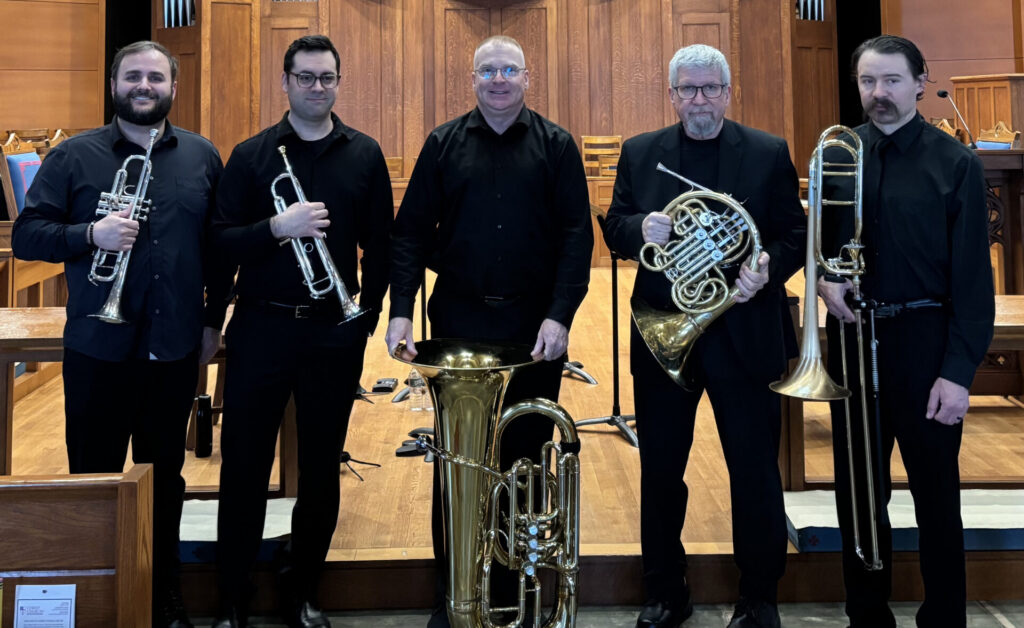
Portsmouth Brass Quintet
Adam Gallant, trumpet
Greg Bechtold, trumpet
Orlando Pandolfi, horn
Brandon Newbould, trombone
Chris Quade, tuba
What Makes This Concert Special?
- Jennifer Higdon is one of the most celebrated American composers of our time, winning the 2010 Pulitzer Prize for Music for her Violin Concerto. Book of Brass showcases her signature style: vivid colors, dramatic contrasts, and the ability to make instrumental ensembles sound almost orchestral in scope. The piece highlights the incredible range of brass instruments from powerful, triumphant fanfares to delicate, shimmering textures.
- George Walker made history in 1996 as the first African American composer to win the Pulitzer Prize for Music. Music for Brass Sacred and Profane reflects his ability to blend the spiritual and the secular, pairing moments of solemn, almost hymn-like beauty with bold rhythmic energy. Walker was also a trailblazing pianist, educator, and the first Black graduate of the Curtis Institute of Music, leaving a lasting legacy as one of America’s most influential composers.
- Simple Gifts has a story beyond Copland. It began as a Shaker song. Copland later used the melody in Appalachian Spring, helping make it widely known.
- Charles Ives grew up hearing music in and around the town bands of Danbury, Connecticut, which his father directed. His father also encouraged him to experiment with sound—even having him sing a tune in one key while the piano played in another. That helps explain why Ives’s music can feel at once familiar and surprising. Five Songs moves through distinct characters and scenes; transcribed for brass, they invite listeners to hear the wit and variety of his writing without the original sung words.
- Published in 1909, Paragon Rag comes from Scott Joplin’s later, remarkably productive period. Ragtime’s rhythmic pull comes from accents that play against a steady beat, creating music that feels buoyant and full of motion. The piece was originally written for piano; in Samuel Pilafian’s arrangement, those interlocking rhythms pass among the brass players.
- When Porgy and Bess opened in 1935, Gershwin brought together his gifts for memorable song and large-scale dramatic writing. The three selections on this program—“I Got Plenty O’ Nuttin’,” “Bess, You Is My Woman Now,” and “It Ain’t Necessarily So”—have very different personalities. Heard without singers in Jack Gale’s brass arrangement, their melodies still carry that range of character. The opera was a collaboration involving George Gershwin, Ira Gershwin, DuBose Heyward, and Dorothy Heyward.
What You'll Hear
Take A Closer Look
- Jennifer Higdon won’t apologize for writing accessible music
- Jennifer Higdon: Music is a family
- The Pulitzer Prizes: Jennifer Higdon
- Jack Van Zandt explores Walter Goehr’s (G. Walter) contributions to British music
- Music and the Holocaust: Walter Goehr
- Ives The Man: His Life
- Ives: A Questions is Better than an Answer
- Copland: The Man Behind the Music
- A Year of Hope for Joplin and Johnson
- GP at the Met: Gershwin’s Porgy and Bess
The Details
- The concert will last approximately 1 hour.
- There is a large parking lot on site where you can park for free. Accessible parking is located directly next to the church.